

(While this post is specific to Iceland, much of the advice applies to seeing the Northern Lights in other countries as well: Finland, Norway, Sweden, and more.)
Many people associate Iceland with the Northern Lights, also known as the Aurora Borealis. Here’s our comprehensive list of facts and tips about the Northern Lights.
The Northern Lights are caused by solar flares from our sun that interact with earth’s magnetic field.
I don’t pretend to know the science behind it, but I do know that you can only see the Northern Lights if you’re pretty far north– close to Earth’s magnetic pole. (Actually, you can see them by the magnetic South Pole as well, though there’s less land down there. The Southern Lights are called “aurora australis” in the Southern Hemisphere!)
You want to be close, but not too close to the magnetic north pole for the best chance to see the Northern Lights. Here’s a rough map I made, centered on the magnetic north polls:
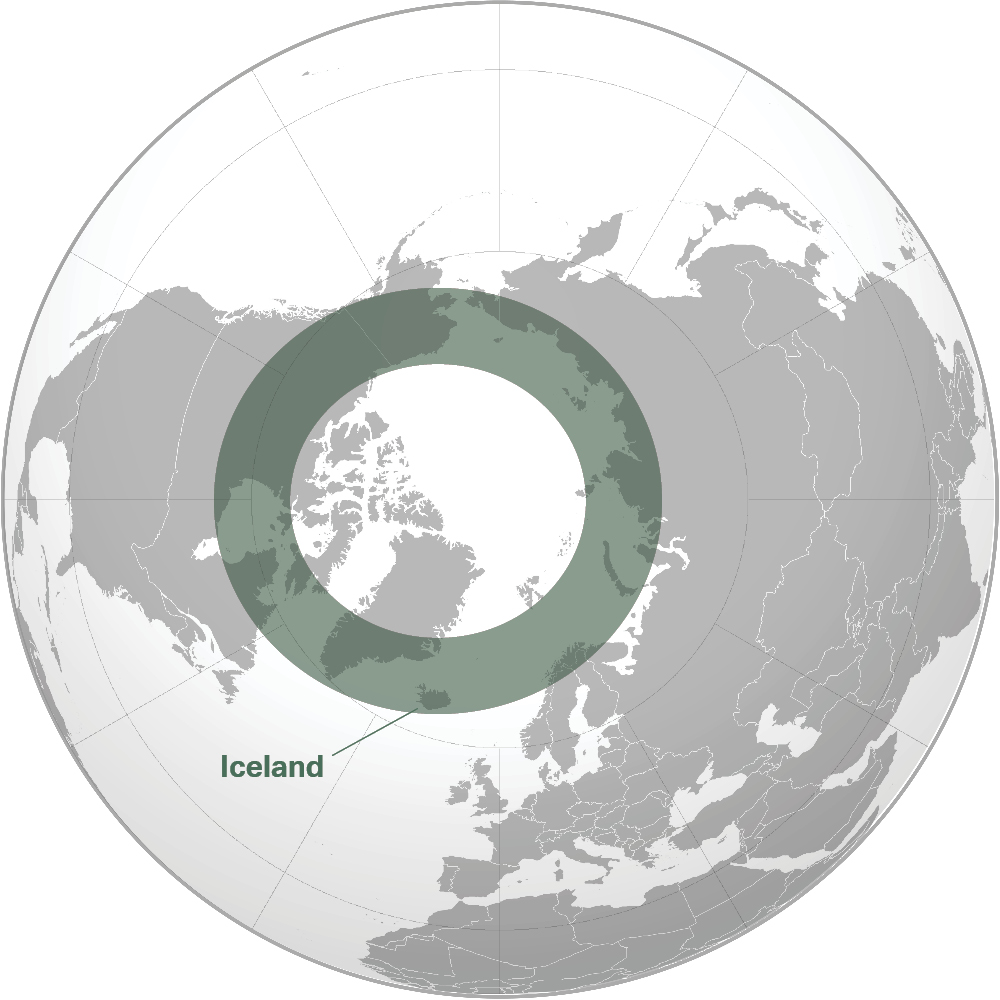
Original map source. I added the freehand green oval on top, so don’t take my addition too seriously. (The original map is licensed under Creative Commons 4.0 International, and my new image is hereby licensed under the same license.)
The green circle / oval shows the approximate area where the Northern Lights are most visible. Notice that it goes right through Iceland. You can see the Northern Lights outside of this circle (and sometimes well outside of this circle), but this is less common.
The Northern lights exist year round, but are only visible when it’s dark
One of the most common questions people ask is, “When can I see the Northern Lights?” You need three things in order to see them: Darkness, a clear sky, and the aurora activity to be happening at that time.
People seem to think that the aurora activity only happens in the winter. But it can and does happen year-round; you just can’t see them in the summer because it’s too light! If you look at the aurora forecast (en.vedur.is), they will predict how much activity there will be, even in the middle of summer. Ask yourself, are the stars visible during the day? Well, no, they aren’t. But the stars are still there—it’s just too bright to see them.
As soon as it is dark enough, you’ll have a chance to see the Northern Lights. So in Iceland, you can only see the Northern Lights from late August until late April. But that sentence simply means, “The sky only gets really dark in Iceland from about late August until late April.”
And if you’re trying to see them at the ends of that range (August to mid-September, or mid March though April), you’ll need to be up between about 11 PM and 4 AM, which is the only time it’s dark enough. And even then, you need strong aurora activity combined with clear skies. When you’re visiting Iceland, especially with kids, you should view the Northern Lights as a potential added bonus, and not a reason to change your vacation to the off season.
See our post about hours of daylight in Iceland. Or go right to Time and Date’s web site to see how much darkness you will have when you are visiting.
We can do a good, but not great job of predicting Northern Lights activity
There are two main places to get aurora activity forecasts. One is the original standard from Iceland’s weather office; that’s the same one I linked to above. There is also a newer web site called http://auroraforecast.is/ that looks to provide similar information.
These forecasts only go out a few days, though. On a Wednesday, you might get a forecast out to Saturday. Both sites use a 0-9 scale. Here’s an example of a period of very high activity:
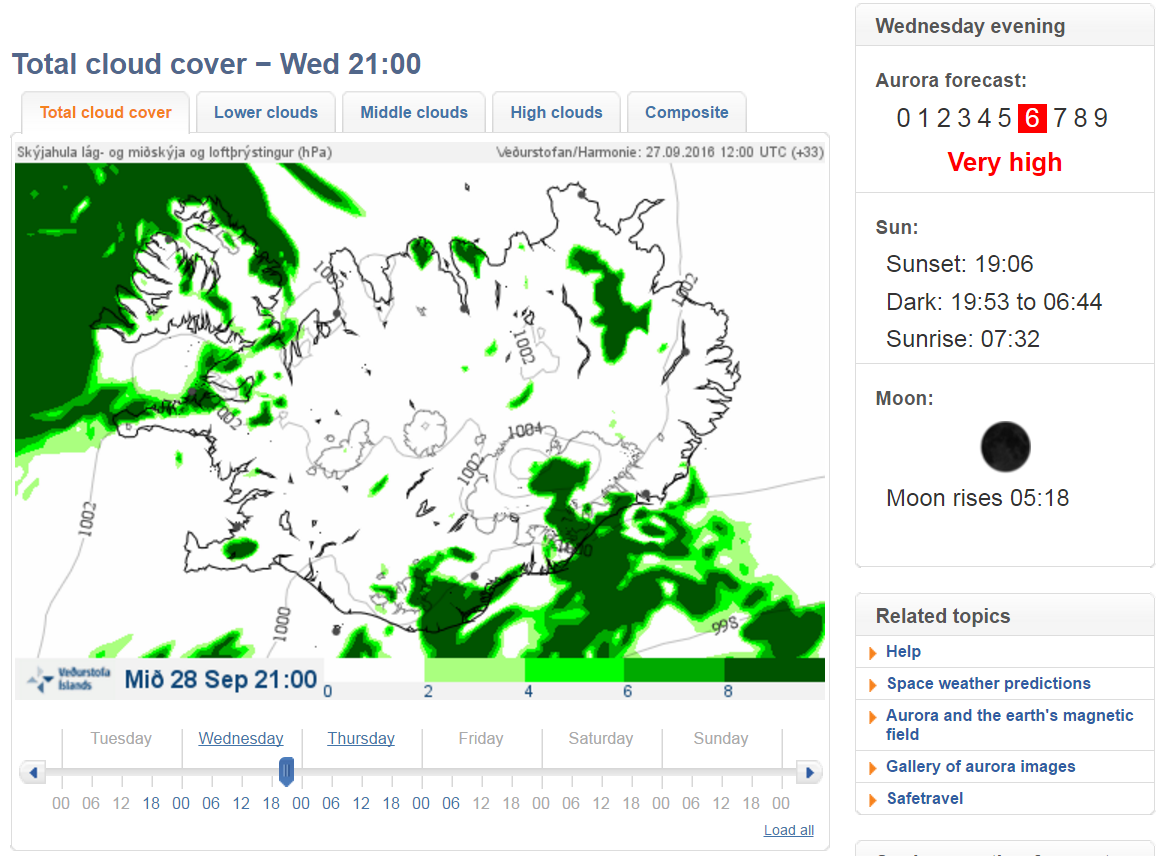
Note that you also need clear skies, so you’re looking at the left side of the screen for cloud cover forecasts and the right side for auroral activity. In this case, most of the country looks like it will have clear viewing.
The 6 out of 9 in the image above is a big deal. It’s very rare, and almost like a national holiday. Seriously– this was September 28, 2016, and Reykjavik turned off the city lights for an hour that night! And yes, people did see the Northern Lights that night. If you’re there for a 3 or 4, you’re doing pretty well.
Northern Lights tours may not be worthwhile … or maybe they are?
Plenty of tour companies in Iceland offer Northern Lights viewing tours. Here’s an example. You’re paying for someone to do what you could do on your own: Drive around to a clear and dark spot for the best chance to see the Northern Lights. The guides on those tours do have an advantage over you: They have friends who will contact them if they see the Northern Lights in the area. And, if you don’t see the Northern Lights, they’ll let you try one more time free of charge.
But if you have a car, you can do your own tour. Look at the cloud cover map, and find a dark safe spot off of the road. (If you need help, here’s a list of sample places you could try. But the list isn’t magical; it’s just some dark safe spots.)
Bring lots of layers of warm clothes, snacks … and a lot of patience!
Pictures you see online may not be accurate.
You can’t just take a picture of the Northern Lights. Well, you can, but you probably won’t see much. Your eyes are much better in very low light than any camera. Take a look at the photo at the top of this post. It’s a beautiful picture of the Northern Lights by Annie Niemaszyk. The details on the page (click “Info”) say that the shutter was left open for 10 seconds to capture that image. The man in the picture had to stay very still!
This image may in fact capture exactly what your eye would see; I have no idea. If the shutter had been left open for 20 seconds, though, the light may have been artificially vibrant. I think some pictures are using some photographic trickery to increase the “wow factor” of the images. Here’s one that left the shutter open for 20 seconds:
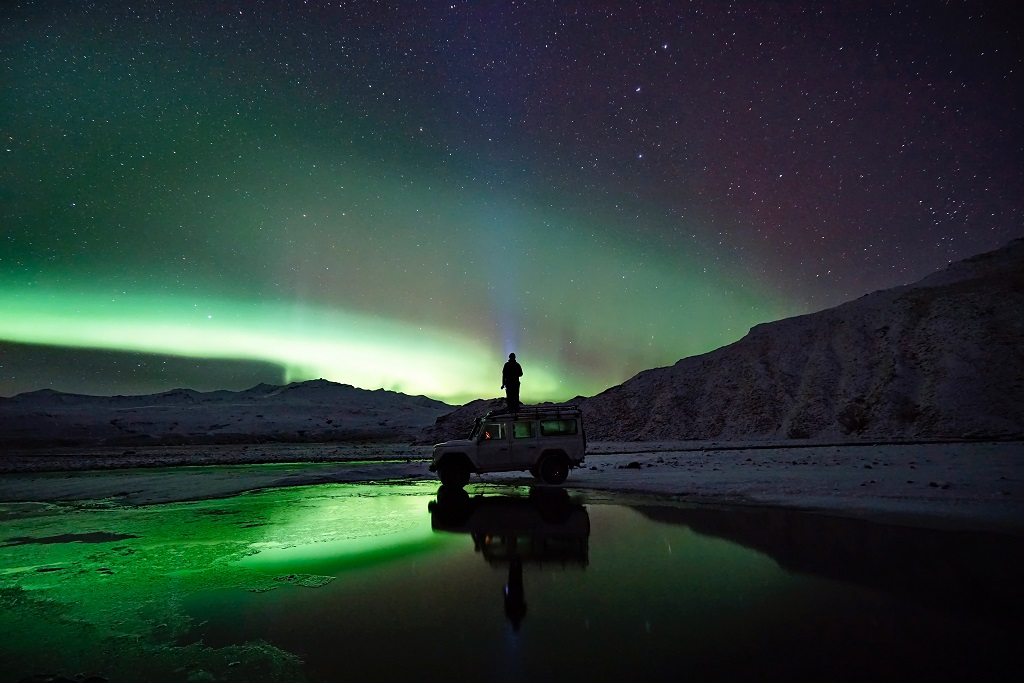
If you leave the shutter open for a long time and use some skills on a photo editing tool like Adobe Lightroom, and you get amazing desktop backgrounds. It’s a beautiful picture, but in my opinion, those stars are too bright to be an accurate portrayal of reality.
Actually, now that I look at the image at the top of the page again, the stars also look very bright …
One positive: The images don’t capture that the lights are moving and dancing around!
Seeing the Northern Lights can be an incredible experience. And Iceland is an excellent place to try to see them. Just remember the 3 rules:
- You need darkness. And there’s no darkness in Iceland in the summer!
- You need auroral activity. Look at forecasts, but know that they aren’t 100% accurate
- You need clear skies.
Let me know in the comments about any tips or experiences you have with seeing the Northern Lights!

I am taking my 2 year old next week we have trips organised for Northern lights, Blue lagoon and whale watching and golden circle and I am very nervous about how he will cope, any words of advice or anything g to help reassure
Hi Claire- sounds like an exciting trip! Here are my thoughts:
– Blue Lagoon: This is easy. It’s about a 45 minute drive from Reykjavik, and the water is wonderful. Enjoy!
– Whale watching: It’s less likely to see whales during the winter. You can usually find a blog or whale watching diary for the company you are going with, to see if they have been seeing whales in recent days. They may also have a wave forecast for the day in the morning. (Special Tours puts out a color code on their ticket booth in the Old Harbor in Reykjavik.) If they aren’t seeing whales, or if the color isn’t green for wave conditions, you may not want to go! If you do go, make sure you bring tons of layers for the 2-year-old. The company will provide coveralls, but they may not have ones small enough for your child. It’s much colder and windier on the water.
– Northern lights: I have similar advice here. If the forecast doesn’t show expected aurora activity, or it shows lots of cloud cover, I would skip this. You can try to see them on your own; some hotels will even call you in the middle of the night if they see the Northern Lights (if you ask for this service!)
I hope you have a great time!