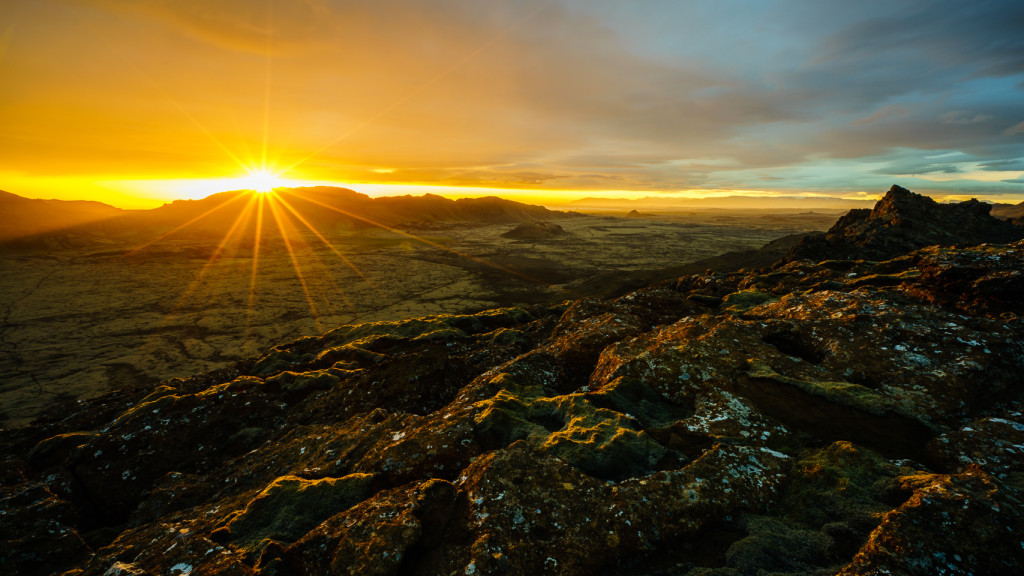

“Midnight Sun” by Hafsteinn Robertsson is licensed under CC BY 2.0
The time of year you visit Iceland will have a definite impact on your experience. Most people assume this is because of the temperature. And there is of course a difference in the temperature by time of year:

Source: http://www.holiday-weather.com/reykjavik/averages/
The graph does what you would expect, with July and August being the hottest months. But if you think about the numbers, I believe the variation isn’t all that dramatic. Those summer highs are only in the mid 50s! And the winter highs are all the way down to the … well, the mid 30s. Yes, you can see some summer days in the 60s or (rarely) in the 70s. But most of the time, you’re still wearing a jacket. Winter just means you wear an extra layer and a hat. And with the wind as it can be, you might be wearing that hat some summer days as well.
I think the bigger difference is in hours of daylight. Take a look:

Source data: http://www.timeanddate.com/
In the middle of June, there are over 21 hours of daylight. In the middle of December, there are right around 4. Now, this is hours between sunrise and sunset. There is still some light outside of these hours. In fact, let’s instead consider “Civil Twilight” (https://en.wikipedia.org/wiki/Twilight#Civil_twilight) which loosely translates to the time between dawn and dusk. Technically, it’s the times when the sun rises above 6 degrees and sets below 6 degrees. Using this definition, the sun never sets (so it never gets below 6 degrees) from around May 20th until July 25th.
Hopefully the idea of the sun never setting for more than 2 months gives you an idea of how different this is from anywhere in the United States. You’ve seen temperatures like those in Iceland, but you simply haven’t seen daylight like this. Just for fun, let’s compare the graph above to the same data for New York City:

And, just for more fun (well, fun for me because I like graphs) here it is extended over 3 calendar years:

So what does that mean for a family visiting Iceland? If you’re there around spring (March or April) or fall (September or October), not much—the days will be about the same length as at home, give or take a couple of hours. You may notice that the CHANGE in daylight is dramatic, though, since you’re on a steep part of the curves above. From mid-February through mid-May, each day brings about 6 ½ minutes more of daylight. So on a week -long trip, your last day would have about 45 minutes more daylight than your first day. Makes sense- the days have to go from 4 hours of daylight to 21 hours of daylight!
In the middle of winter, it means there will be usable daylight from about 10 AM until 5 PM or so. Now, “usable” is very subjective. Just remember that at the extremes of that range, a few bright stars and planets will still be visible.
In the middle of summer, there will literally be usable daylight for 24 hours a day. This is great until it’s 11 PM, you’ve forgotten to eat dinner, and your hotel room is still bright as day. I think blackout curtains in a hotel are mandatory, though you may be fine. Just know that many, but not all, lodgings offer blackout curtains.
Let me know about any experiences you have had with extreme daylight, long or short. Did your hotel have blackout curtains? Did you need them? Did the lack of winter daylight cramp your style?

How are you doing with the daylight? Have there been blackout curtains?
Setting off to Iceland on July 11 with two children (13 and 10) so really enjoying your posts.
Hi Richard,
Glad you are enjoying our posts! Blackout curtains have been hit or miss. Nearly all places have something to cover the windows. But some of the blackout shades leave large enough gaps at the sides that the room is still very bright. And others are thinner curtains that don’t block much light. The kids actually celebrate when we arrive at a new house with dark bedrooms!
It has only been a problem in one or two places, where the kids have had some trouble falling asleep. We’ve stuffed pillows or towels in some window corners, but there are times I wish we had some extra fabric with us! But again, most of the time it hasn’t been too bad.